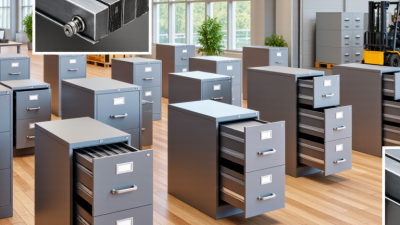
China remains a major manufacturing base for steel furniture, supported by extensive metal-processing capacity and mature export supply chains. World Steel Association data recorded China’s crude steel production at approximately 1.01 billion tonnes in 2024. That scale does not guarantee excellent cabinets. It does, however, explain why many competitive steel filing cabinets manufacturers operate there.
Market intelligence from Grand View Research and The Freedonia Group continues to identify durability, office modernization, and organized storage as important filing cabinet demand factors. Their reports also suggest that buyers increasingly compare lifecycle value, not only purchase price. This matters in practical use. A well-built cabinet should open smoothly, resist tipping, and protect documents from dust and daily handling. Thin steel may appear acceptable online. It can flex around the drawer rails after months of use.
This guide examines leading Chinese suppliers through manufacturing experience, material specifications, quality controls, export capability, and customer support. It considers details such as cold-rolled steel thickness, powder-coating consistency, drawer load capacity, lock quality, and packaging protection. Certifications and factory audits provide useful evidence, but they do not replace product inspection. The comparison is not flawless. Supplier rankings can change with new equipment, management decisions, or changing export markets.
Reliable selection requires more than a polished catalog. Buyers should request samples, technical drawings, test reports, and clear warranty terms before placing volume orders. Factory communication also matters. Delayed answers often reveal future service problems. By combining published industry research with practical purchasing criteria, this overview aims to identify China’s most dependable steel filing cabinets manufacturers for offices, archives, schools, and commercial facilities. Performance comes first. Price still matters.
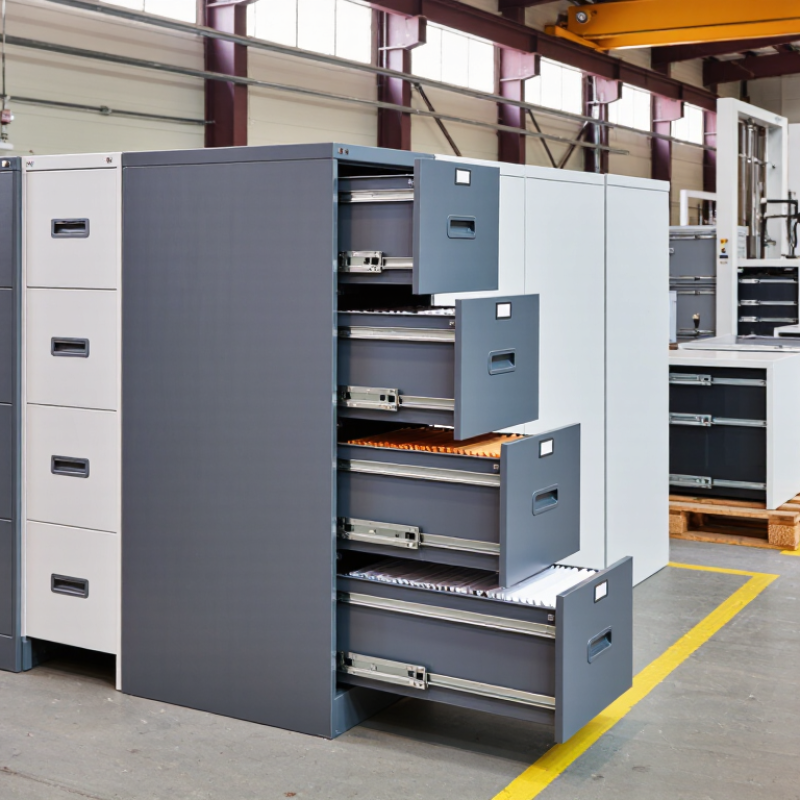
A top steel filing cabinet manufacturer in China is defined by process control, not factory size alone. China produced about 1.005 billion tonnes of crude steel in 2024, according to World Steel Association data. This deep supply base supports material availability, but steel volume does not prove cabinet quality.
Reliable manufacturers publish steel thickness, load ratings, and dimensional tolerances. They test drawer movement after repeated opening cycles. They also inspect weld penetration, corner strength, coating adhesion, and anti-tip performance. Powder coating should resist scratches and corrosion in ordinary office conditions. Ask for batch records, inspection photos, and measurable test results. ISO 9001 certification can support confidence, yet certification alone is not enough. The latest ISO Survey records China among the largest holders of quality-management certificates worldwide.
Details matter. Drawers should align evenly, close without grinding, and carry stated loads without distortion. Lock cylinders need consistent operation. Packaging should protect corners during long-distance shipment. A capable factory can explain its corrective-action process when defects appear. That response reveals more than a polished showroom.
No manufacturer is flawless. A low defect rate still needs verification. Buyers should sample finished units, not only review documents. Price remains important, but a cheaper cabinet may hide thinner steel, weaker runners, or inconsistent coating. Independent inspection adds time and cost. It can prevent a much larger replacement problem.
A leading steel filing cabinet manufacturer is typically evaluated by practical procurement criteria: cold-rolled steel construction, drawer load capacity, corrosion protection, product durability, and quality-control coverage. The benchmark values shown represent common commercial specification targets rather than data from any individual company or brand.
China’s steel filing cabinet industry is concentrated in several practical manufacturing regions. Guangdong supports export-oriented production, with strong metal fabrication and port access. Jiangsu and Zhejiang offer mature supply chains for sheet steel, hardware, locks, and packaging. Hebei remains important for steel processing and cost-efficient production. Each region has different strengths. Factory location affects lead time, tooling support, and shipping costs.
Industrial capability is more important than location alone. Qualified manufacturers commonly use laser cutting, CNC bending, robotic welding, and electrostatic powder coating. These processes create cleaner edges, stable dimensions, and better surface protection.
Reliable factories also control steel thickness, drawer alignment, load capacity, and coating adhesion. On-site inspections should include sample measurements and repeated drawer testing. A polished showroom can still hide inconsistent production. That deserves attention.
Tips: Ask for material specifications, coating test records, and recent inspection reports. Confirm whether production is automated or heavily manual. Review carton strength, corner protection, and spare-hardware policies. Small details matter. It is also wise to compare pilot samples before placing a large order. A cheaper cabinet may use thinner steel or weaker slides, although this is not always obvious from photographs. Regional advantages help, but transparent quality controls provide stronger evidence of manufacturing reliability.
China’s steel supply supports large-scale cabinet manufacturing. The World Steel Association reported 1.019 billion metric tons of Chinese crude steel production in 2023. This capacity helps manufacturers offer two-drawer, three-drawer, four-drawer, lateral, mobile, and pedestal cabinets. Grand View Research also identifies office furniture as a steadily expanding global market, driven by workplace organization and space efficiency.
Customization is often the real purchasing advantage. Buyers can request galvanized or cold-rolled steel, powder-coated finishes, adjustable shelves, full-extension runners, central locking, anti-tilt mechanisms, and color matching. Some factories produce narrow cabinets for corridors, while others build wide lateral units for engineering drawings. Fire-resistant construction requires separate testing, not just thicker steel. That distinction is frequently overlooked.
Tips: Ask for steel thickness, drawer load ratings, salt-spray results, and cycle-test records. Check samples before approving bulk production. A cabinet may look strong but feel unstable when fully loaded. Require inspection photos, packaging details, and measurement tolerances. EN 14073 and ANSI/BIFMA guidance can support practical safety checks, although requirements vary by market. Custom logos and colors are easy; reliable alignment and smooth operation are harder. Manufacturers should explain both their capability and its limits.
Top Steel Filing Cabinets Manufacturers in China
Reliable steel filing cabinets begin with measurable standards, not polished photographs. The World Steel Association reported 1.89 billion tonnes of crude steel production in 2023. Large output does not automatically mean consistent quality. Buyers should request heat numbers, material certificates, and traceable inspection records. Cold-rolled steel is common because it offers a smooth surface and stable forming performance. Typical cabinet panels use different gauges, depending on load requirements and design. Thicker steel improves rigidity, but increases weight and cost. Small defects matter.
Tips: Ask for ISO 9001 quality records and independent test reports. Check cabinet dimensions, drawer load tests, coating adhesion, and corrosion resistance. ASTM D3359 can assess paint adhesion, while ISO 9227 supports salt-spray evaluation. These tests help, but they cannot replace factory audits.
Production quality depends on more than the raw sheet. Modern lines usually combine laser cutting, CNC punching, bending, spot welding, surface cleaning, and powder coating. Every stage can leave a visible clue. Uneven gaps may indicate poor bending control. Sharp internal edges suggest weak finishing inspection. The International Energy Agency estimates steelmaking creates around 7% to 9% of global energy-related emissions, so material efficiency also deserves attention. Scrap recovery and optimized nesting can reduce waste. Still, no production plan is flawless. A responsible manufacturer records nonconformities and improves the process instead of hiding them.
| Evaluation Dimension | Production or Quality Item | Typical Industry Specification | Common Standard or Reference | Recommended Verification Method |
|---|---|---|---|---|
| Quality Management | Quality management system | Documented inspection, corrective-action, and traceability procedures | ISO 9001:2015 | Review the valid certificate scope, internal inspection records, and batch traceability documents. |
| Environmental Management | Environmental control during manufacturing | Controls for energy use, waste handling, emissions, and chemical storage | ISO 14001:2015 | Check the certificate scope and evidence of waste-disposal and environmental-control procedures. |
| Occupational Safety | Workplace health and safety management | Risk assessment, worker training, emergency procedures, and protective equipment | ISO 45001:2018 | Review the management-system certificate and workplace safety records. |
| Base Material | Cold-rolled steel sheet | SPCC or equivalent commercial-quality cold-rolled steel | JIS G 3141 or equivalent purchasing specification | Verify the material certificate, steel grade, thickness, and heat or batch number. |
| Sheet Thickness | Cabinet body, doors, and drawer components | Approximately 0.6–1.2 mm, depending on load and cabinet design | Project-specific technical drawing and load specification | Measure multiple locations with a calibrated micrometer before forming. |
| Corrosion Protection | Pre-treatment before powder coating | Degreasing, rinsing, chemical conversion, and controlled drying | Process specification based on ISO 12944 corrosion categories | Audit chemical concentration, bath temperature, treatment time, and surface cleanliness. |
| Surface Finish | Thermosetting powder coating | Typical dry-film thickness: approximately 60–100 μm | ISO 2808 for coating-thickness measurement | Use a calibrated coating-thickness gauge at several points on each finished panel. |
| Coating Adhesion | Bonding strength between coating and steel | Uniform coating without peeling, blistering, or exposed substrate | ISO 2409 or ASTM D3359 | Perform a cross-cut or equivalent adhesion test on representative production samples. |
| Corrosion Testing | Resistance of coated panels to salt spray | Test duration should be defined by the purchase specification; 240–500 hours is commonly used for general indoor products | ISO 9227 or ASTM B117 | Evaluate corrosion, blistering, and under-film creep using an agreed acceptance criterion. |
| Cutting and Punching | Laser cutting, shearing, and CNC punching | Consistent hole position, clean edges, and minimal burrs | Approved engineering drawing and tolerance specification | Inspect hole diameter, position, edge condition, and dimensional repeatability. |
| Forming | Bending and panel reinforcement | Accurate bends with reinforced folds at load-bearing edges and drawer openings | Approved drawings and first-article inspection plan | Check bend angle, flange dimensions, squareness, and deformation under assembly loads. |
| Welding | Resistance spot welding and seam joining | Even weld spacing, secure joints, and no sharp exposed weld spatter | ISO 3834 principles and approved welding procedure | Use visual inspection and destructive or non-destructive sampling according to risk level. |
| Assembly | Doors, drawers, runners, hinges, and locks | Smooth operation, consistent gaps, secure hardware, and correct alignment | Approved assembly drawing and functional test plan | Open and close each drawer or door repeatedly; inspect alignment, movement, and locking function. |
| Load Performance | Drawer and shelf load capacity | Capacity must be declared separately for each model; commonly specified per drawer or shelf | Manufacturer’s tested load specification and applicable furniture requirements | Apply the specified static load and inspect permanent deformation, runner movement, and stability. |
| Safety Design | Anti-tip and stability protection | Interlocking drawers, anchoring provisions, rounded or protected edges, and stable footprint | Applicable workplace-furniture safety requirements and project specification | Verify anti-tip operation, anchoring points, edge safety, and tip-resistance test results. |
| Dimensional Control | Overall cabinet dimensions | Typical office filing units: approximately 900–2000 mm high and 380–1000 mm wide | Approved product drawing and agreed dimensional tolerances | Measure height, width, depth, diagonal squareness, and door or drawer clearances. |
| Final Inspection | Appearance and workmanship | No visible scratches, dents, sharp edges, coating defects, or missing hardware | Approved sample, inspection checklist, and agreed AQL plan | Conduct visual inspection under consistent lighting and record defects by severity. |
| Packaging | Protection during domestic and export transportation | Corner protection, moisture-resistant wrapping, carton or reinforced packaging, and handling labels | Agreed packing specification and transport-test requirements | Inspect packaging strength, product restraint, barcode or label accuracy, and drop-test results where required. |
Evaluating Chinese steel filing cabinet manufacturers requires more than comparing prices. The World Steel Association reported approximately 1.02 billion tonnes of crude steel production in China in 2023. Large output does not automatically mean consistent cabinet quality. Ask for steel grade, thickness, welding details, and traceable material records. A reliable factory should provide production samples, inspection reports, and clear tolerance limits. Check drawer load tests, anti-tilt performance, lock cycling, and powder-coating adhesion. Relevant standards, such as EN 14073 and EN 16121, can help define testing expectations. However, certificates alone prove little.
Visit the production line when possible. Look for automated cutting, controlled welding, clean pretreatment tanks, and a dry, even coating surface. Request batch photographs before shipment. The 2023 ISO Survey recorded more than one million ISO 9001 certificates worldwide, yet a certificate cannot replace process evidence. Review the manufacturer’s corrective-action records and complaint response time. Ask how they handle warped panels, damaged corners, and missing keys. Small details matter.
Tips: Compare three physical samples, not only catalogs. Measure panel thickness with a gauge. Open every drawer repeatedly. Request packaging-drop test results. Confirm spare-part availability and inspection responsibility in writing. A lower quotation may hide thinner steel or weaker runners. I would also inspect one finished unit myself; photographs can be flattering. Leave room for doubt.